⚡ The short answer
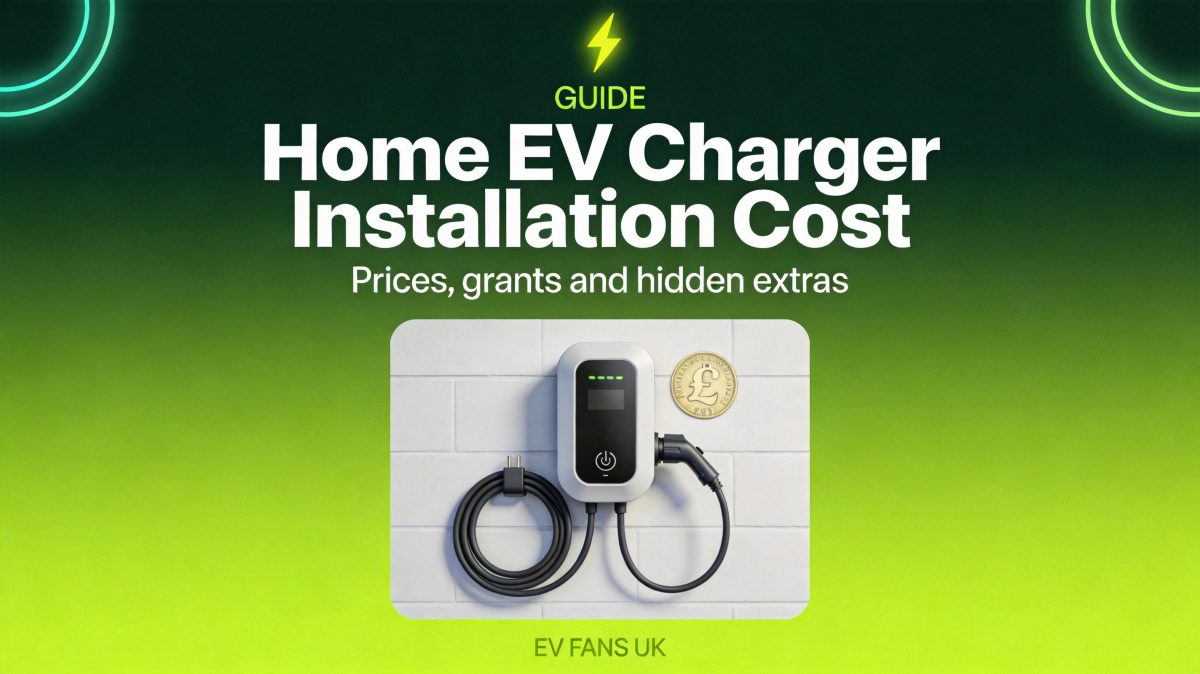
A home EV charger costs £800–£1,200 installed in 2026, averaging around £1,110 for a standard 7kW unit. The EV Chargepoint Grant covers 75% of hardware and installation, capped at £500 per socket, but only for renters, flat owners and landlords — not homeowners in houses with a driveway.
Installing a charger is the single biggest fixed cost of switching to an electric car, and the single biggest driver of whether that car is cheap or expensive to run. A wallbox paid for once and used on an off-peak tariff turns every mile into a few pence; skip it, and you are exposed to a public rapid network where the UK average was around 79p per kWh in September 2026.
So what does the work actually cost, and what is negotiable? Here is the 2026 picture, based on current UK installer price guides.
What you pay: the headline numbers
Most UK homes get a single 7kW wall-mounted charger, and a straightforward installation near the consumer unit lands between £800 and £1,200 including VAT, with a typical figure around £1,110 supplied and fitted. That price covers the unit, the electrical connection, testing and certification.
Break it down and the shape of the bill becomes clearer:
| Cost element | Typical range | Notes |
|---|---|---|
| Chargepoint unit | £300–£900 | Basic smart unit £300–£500; premium solar or V2H-capable units up to £900 |
| Installation labour | £200–£500 | Higher for long cable runs, consumer unit work or three-phase |
| All-in, before grant | £800–£1,200 | Standard single-phase job, 7kW |
| All-in, after grant | £500–£900 | Eligible households only, where the £500 cap applies |
The grants that change the maths
There are three separate government schemes, and the eligibility rules differ enough that people routinely claim the wrong one — or assume they qualify when they do not.
The EV Chargepoint Grant covers 75% of the combined cost of buying and installing a socket, capped at £500 per socket. The cap rose from £350 on 1 April 2026 and the scheme is confirmed until 31 March 2027. Because it is a percentage rather than a flat discount, the breakpoint is £667: any job costing more than that receives the full £500. Since most real installations exceed it, eligible households usually get the maximum.
The catch is who is eligible. The grant is open to renters in any residential property (with landlord permission), flat owner-occupiers with a private parking space, residential landlords, and small businesses. Homeowners who own and live in a house with their own driveway are not eligible. It is paid as a discount on your invoice by the installer, who must be OZEV-authorised and must fit a charger on the approved product list.
The EV Chargepoint Grant for Households with On-Street Parking is the route for drivers with no off-street parking. It also covers 75% of the cost up to £500, but requires a cross-pavement charging solution and consent from your local highways authority. This is the scheme that the new permitted development right for cross-pavement charging — confirmed in September 2026 — is designed to make practical, by removing the need for a separate planning application.
The Workplace Charging Scheme works differently again: your employer applies, and it covers 75% of installation costs up to £500 per socket. If your workplace is considering chargers, it is worth flagging — and it is one reason some salary sacrifice and fleet packages come with charging included.
What the total actually looks like
| Installation total | Grant (75% capped at £500) | You pay |
|---|---|---|
| £600 | £450 | £150 |
| £667 | £500 | £167 |
| £800 | £500 | £300 |
| £1,110 (average) | £500 | £610 |
| £1,200 | £500 | £700 |
If you are eligible, the grant typically pays for a third to a half of the job. If you are not — and that includes most homeowners in houses — budget the full £1,000-plus and treat the grant question as closed.
What pushes the price up
Five factors explain almost all the variance between quotes:
Distance from the consumer unit. Cable and labour scale with the run. A charger on the far side of the house from the fuse board, or in a detached garage, can add several hundred pounds.
Consumer unit capacity. If there is no spare way on the board, or the existing unit cannot support the additional load, an upgrade adds roughly £300–£800. This is the most common extra.
PME protection. Most UK homes have a PME earthing arrangement, which now requires protection for EV charging — usually a device fitted at or near the charger, adding roughly £100–£250.
Groundworks and surface type. Chasing cable into brick or concrete, lifting block paving or crossing a gardener's pride and joy costs more than surface-mounting along a wall.
Location. London and the South East carry roughly 20–30% higher labour rates, and three-phase installation — needed for 22kW charging — costs more in both equipment and labour.
One warning worth stating plainly: the work is notifiable and must be carried out by a Part P registered electrician, and an OZEV-approved installer if you want the grant. Quotes that undercut the market substantially usually mean either a non-compliant installation or a charger outside the approved list.
Which charger should you actually buy?
For most drivers, a 7kW smart charger is the right answer. It adds roughly 25–30 miles of range per hour, which refills a typical family EV overnight in four to eight hours — a pattern that fits how most people actually use a car. A 22kW unit only delivers its full speed on cars with a three-phase onboard charger, and requires a three-phase supply that most homes do not have.
Smart functionality is not optional in practice: the EV Smart Chargepoint Regulations require it for new domestic installations, and it is what allows a charger to respond to off-peak tariffs and grid signals. That matters more than brand prestige, because the tariff you pair with the charger determines your running cost far more than the hardware does.
Manufacturer bundles are worth comparing before you buy separately. Mercedes, for example, is offering EV customers a £250 discount on Pod Point home chargers after Pod Point became the brand's sole home charging provider — the kind of tie-in that effectively absorbs most of the post-grant cost.
Checks before you sign
Confirm the installer is OZEV-approved and Part P registered, and ask for the grant to be applied at invoice rather than claiming it yourself — you cannot. Get at least three quotes and compare the line items, not just the total, since a cheap headline figure often excludes consumer unit work. Ask whether the price includes the DNO notification if one is needed, and how long the warranty runs on both the unit and the workmanship.
Then think about the tariff: the charging cost calculator shows what your mileage costs on home, on-street and rapid charging, and our guide to what charging really costs breaks the comparison down per mile. If you are still choosing a car, the new cross-pavement charging rules matter if you have no driveway, and our complete home charging guide covers the practical decisions from cable routing to load management.
Sources
Eco Harmony — Home EV Charger Costs UK 2026 (https://ecoharmony.co.uk/blogs/plug-in-power-up/home-ev-charger-costs-uk) · E Chargers UK — 2026 OZEV Home EV Charger Grant: What You Need to Know (https://www.echargersuk.co.uk/blogs/news/domestic-ev-charger-grants-in-2026-what-you-need-to-know) · Solar Info UK — Home EV Chargers in the UK (https://www.solarinfo.uk/ev-chargers) · Fantastic Services — How much does EV charger installation cost? 2026 UK price guide (https://www.fantasticservices.com/cost-guides/electrical/ev-charger-installation/) · Tesla Charger UK — OZEV grant eligibility and calculations (https://teslacharger.co.uk/ozev-grant/) · GOV.UK / Find Government Grants — Electric Vehicle Chargepoint Grant for Households with On-Street Parking (https://www.find-government-grants.service.gov.uk/grants/electric-vehicle-chargepoint-grant-for-households-with-on-street-parking-1) · EV Powered — Mercedes offering EV customers a £250 price cut on Pod Point home charger, 31 August 2026 (https://evpowered.co.uk/) · ChargeNet UK — Public rapid and ultra-rapid DC charging prices, 11 September 2026 (https://www.chargenet.co.uk/)