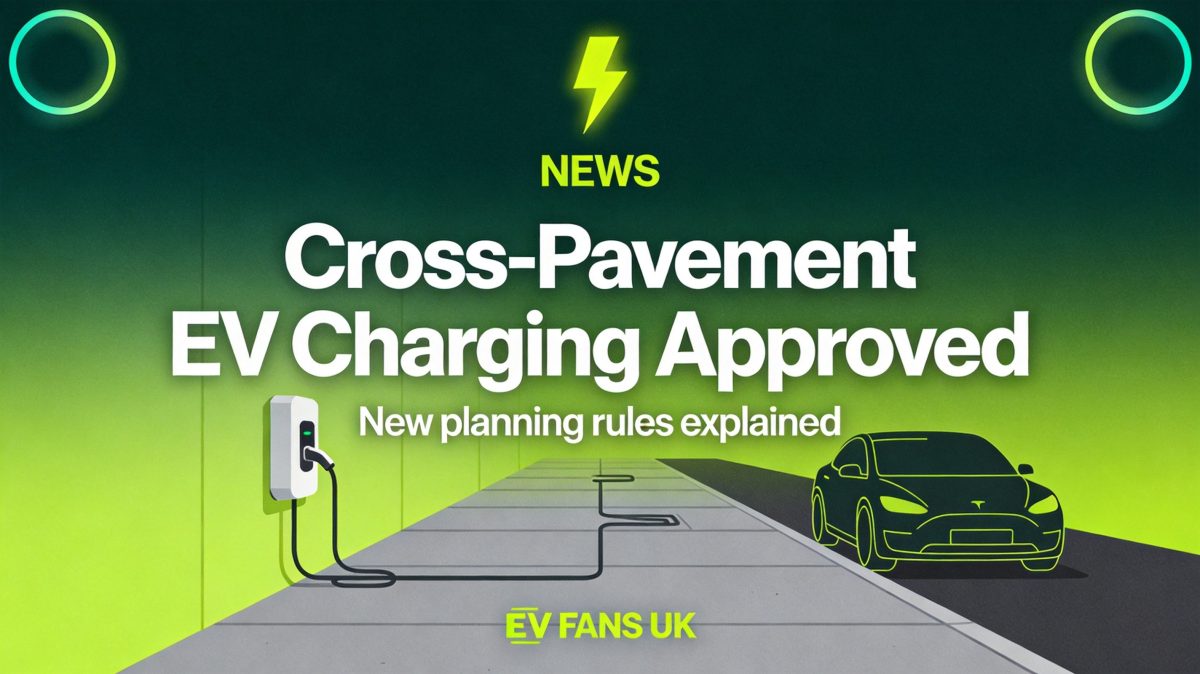
⚡ Planning permission is going — the cross-pavement charging rule just changed
On Friday 11 September 2026 the government confirmed a new permitted development right for cross-pavement charging in England. A cable channel under the pavement will no longer need a planning application, but highways consent, street works permission and the installation bill remain. Secondary legislation is due this autumn.
If you park on the street, the economics of an electric car work differently. The cheap electricity is inside your house; the car is on the other side of a public footway. Cross-pavement charging solves that with a channel — usually called a gully — sunk into the pavement so a cable can run safely between a wallbox and the car at the kerb.
Until this month, the hardware was rarely the obstacle. The paperwork was. That changed on Friday 11 September 2026, when the Department for Transport published its response to the consultation on EV charging and permitted development rights, confirming that a new national permitted development right (PDR) will be created for cross-pavement solutions and the domestic chargepoint they serve.
What has actually been confirmed
Three changes were announced together, and it is worth separating them.
1. Cross-pavement charging moves out of the planning system. Installing a cross-pavement solution and its associated home chargepoint will no longer require a separate planning application. Planning permission will be granted nationally through the PDR, which is the mechanism that already lets most driveways, extensions and non-domestic chargepoints proceed without an application. Of the consultation responses that addressed the proposal, 104 supported it.
2. Local oversight does not disappear. The PDR comes with conditions, limitations and prior approval where appropriate, and the existing Highways Act 1980 permission — the consent a council gives as highway authority for a cable to cross the pavement — still applies, as do street works permissions. Councils keep the power to refuse. In practice, that means the change removes one of three permissions rather than all of them.
3. Commercial charging gets slightly easier too. Cumulative equipment housing in a non-domestic car park rises from 29 cubic metres to 45 cubic metres, and multiple units of housing or storage cabinets will be allowed. That is aimed at multi-bay rapid sites and dealership forecourts rather than households, but it removes a real constraint on larger installations.
Why planning was the bottleneck
Under the rules in force until now, a householder without off-street parking faced up to three separate consents: planning permission for the cross-pavement solution and chargepoint; permission from the local authority in its capacity as highway authority under section 178 of the Highways Act 1980 for the cable to be laid across the pavement; and street works permissions under the New Roads and Street Works Act 1991.
Three processes, three sets of fees, and three chances for a scheme to stall in a department that may have no one responsible for EV charging. The government's own consultation documents acknowledge the second and third consents are still needed and are not proposed to change, but it is the planning application — the slowest and least predictable of the three — that the PDR removes.
The safety rationale for keeping councils involved is straightforward. A trailing cable is a trip hazard, particularly for pedestrians with mobility or visual impairments, and the standards for reinstating the pavement after a channel is cut are set out in an addendum to the Specification for the Reinstatement of Openings in Highways published in 2024. Prior approval allows a council to check that before installation rather than after.
What it means if you do not have a driveway
Around four in ten UK households have no off-street parking, which puts home charging — the cheapest way to run an EV — out of reach unless a cross-pavement solution or an on-street chargepoint is available. Charging on the public network can cost up to ten times more per kilowatt hour than a domestic off-peak tariff, and that spread is the single biggest running-cost penalty facing drivers without a driveway.
Removing the planning step shortens the process and cuts the cost of getting to a live installation. It also unlocks a specific grant that many drivers do not know exists: the Electric Vehicle Chargepoint Grant for Households with On-Street Parking covers 75% of the cost of buying and installing a socket, up to £500, and it requires a cross-pavement solution plus highways authority consent. It runs to 31 March 2027.
The grant is paid at the point of installation by an approved installer, so the caps and eligibility are worth checking before you commission work. Our guide to UK EV grants and incentives in 2026 lists the current schemes, and the home charger installation cost breakdown sets out what a typical job costs once the grant is applied.
The gap that remains: councils, not legislation
Legislation is not the only constraint. Vauxhall's Freedom of Information research, published on 8 September 2026 and covering 414 UK councils between May and July 2026, found that more than 90% of councils have at least one public charger somewhere in their area — but half still offer no on-street charging at all. On-street provision has improved from 31% of councils in 2023 to 39% in 2026, and 32% now publish a residential on-street charging strategy, up from far fewer three years ago.
Where a council does commit, the results are visible. Coventry's partnership with Connected Kerb has built a network of 1,856 charging sockets used by more than 9,000 registered residents. Where there is no published strategy and no dedicated officer — 54% of councils still have neither — a permitted development right will not by itself deliver hardware.
That is the honest caveat for drivers reading this as a green light: the change makes a well-supported installation quicker and cheaper, not automatic. If your council has no cross-pavement policy, the highways consent remains the gate.
What happens next
The reforms are not yet in force. Secondary legislation is expected to be laid before Parliament during autumn 2026, subject to parliamentary time, with commencement after that. Until it commences, the old three-permission route applies, and any application already in the system will be determined under the rules in force when it was made.
If you are weighing up an electric car and your charging plan depends on a cable channel, the practical steps are: check whether your council has a published cross-pavement policy and an EV charging officer; ask the highways team what section 178 consent requires locally; get quotes from installers who work with approved gully systems; and confirm grant eligibility before signing. To understand what the alternative costs, our charging cost calculator compares home, on-street and rapid pricing, and the UK charging points directory shows what is already live near you.
If you have not yet chosen a car, the running-cost advantage of home charging is worth factoring into the model decision itself — browse the electric car library for real-world range figures, and compare annual tax with the VED calculator.
Sources
GOV.UK — Changes to various permitted development rights for EV charging, consultation (https://www.gov.uk/government/consultations/electric-vehicle-charging-changes-to-permitted-development-rights/changes-to-various-permitted-development-rights-for-ev-charging) · EVA England — Government backs simpler home EV charging for drivers without driveways, 14 September 2026 (https://www.evaengland.org.uk/2026/09/14/government-backs-simpler-home-ev-charging-for-drivers-without-driveways/) · Transport & Energy — UK Government confirms plans to simplify cross-pavement charging installations, 15 September 2026 (https://transportandenergy.com/2026/09/15/uk-government-confirms-plans-to-simplify-cross-pavement-charging-installations/) · Industry News — Planning changes aim to remove barriers to private EV demand, 15 September 2026 (https://industry-news.biz/planning-changes-aim-to-remove-barriers-to-private-ev-demand/) · Stellantis/Vauxhall press release — 90% of UK councils have public EV charging available, but half still do not offer on-street access, 8 September 2026 (https://www.media.stellantis.com/uk-en/vauxhall/press/90-of-uk-councils-have-public-ev-charging-available-but-half-still-do-not-offer-on-street-access) · Highways Industry — Half of councils still have no on-street EV chargers for residents without driveways, 14 September 2026 (https://www.highwaysindustry.com/on-street-ev-chargers-councils/) · GOV.UK — Electric Vehicle Chargepoint Grant for Households with On-Street Parking (https://www.find-government-grants.service.gov.uk/grants/electric-vehicle-chargepoint-grant-for-households-with-on-street-parking-1)