⚡ The short version
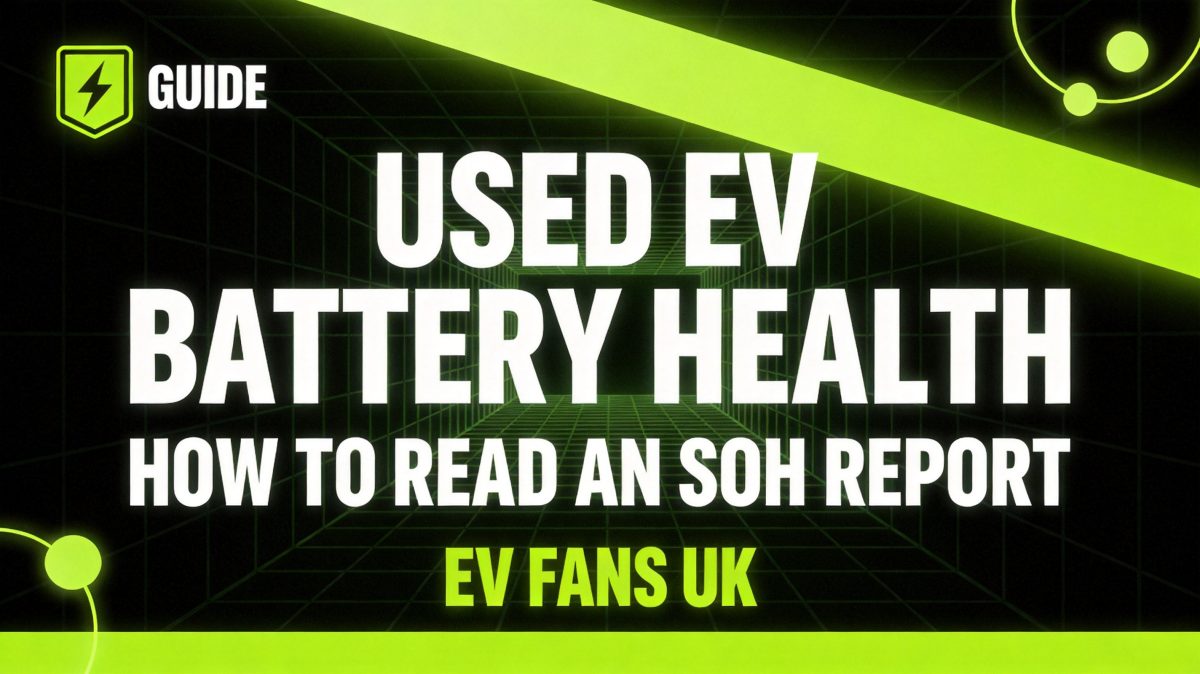
The biggest risk when buying a used electric car is the battery, and the most useful number is State of Health (SoH). A three-year-old EV reading 88% SoH is normal; one reading 71% is a £6,000 problem. Here is how SoH is measured, what counts as good, what a test costs (roughly £50–£100), and the questions to ask before you pay.
Used EV sales in the UK are growing far faster than the new market: around 87,000 used battery electric cars changed hands in the first quarter of 2026 alone, up roughly 32% year on year. Most of those buyers are being sold on low running costs — but that promise depends on one component.
The battery in a used EV is a consumable, not a lifetime part, and it is the most expensive single item on the car. Our breakdown of EV battery replacement costs in the UK shows why a poor SoH figure can wipe out years of fuel savings. This guide explains SoH in plain English and covers what to check; our broader used EV buying guide handles everything else, from charging cables to warranty transfers.
What State of Health actually measures
SoH is the percentage of a battery's original usable capacity that remains. A new pack reads 100%. A car at 88% SoH has lost 12% of capacity, which in practice means roughly 12% less range than the day it left the showroom.
Two things matter here. Degradation is not linear: most packs lose a few per cent quickly in year one, then decline slowly and almost flatly for years, so a car at 94% after twelve months is not heading for 50% by year six. And SoH is not range — range also depends on temperature, driving style, tyres and motor efficiency, so a 90% SoH car driven gently in summer can out-range a 95% SoH car hammered in February. Use SoH to judge the battery, not to predict your commute.
What counts as a good SoH number
There is no legal pass mark, but the market has settled on clear bands, supported by UK fleet data showing medians of roughly 93–94% at four to five years old and 85% at eight to nine years old.
| SoH reading | What it means | What to do |
|---|---|---|
| Above 90% | Healthy; normal up to about 5–6 years old. | Proceed on price and condition. |
| 80–90% | Good; typical for a 6–10 year old EV. | Fair to buy; factor in the range loss. |
| 70–80% | Below par for the age; near warranty thresholds. | Negotiate hard, or walk away. |
| Under 70% | Usually outside the manufacturer warranty threshold. | Price as needing a battery repair, or avoid. |
Age and mileage give the figure its context. An 82% SoH car that is nine years old with 90,000 miles is behaving normally. The same 82% on a three-year-old, 20,000-mile car has been abused — most likely rapid-charged to 100% daily and left standing in the sun.
Four ways to get an SoH figure
1. Independent third-party test (most reliable). AVILOO and similar providers plug into the car's OBD-2 diagnostic port and issue a certificate to TÜV standards. Their flash test takes about three minutes; the fuller version needs a drive cycle. Budget around £100 and expect a document you can hold a seller to.
2. Independent garage OBD scan (good value). Many EV specialists will read the battery management system for £50–£100 and print reported SoH alongside cell balance and fault codes. A spread of more than about 5% between highest and lowest module is a warning sign even when SoH looks fine.
3. Manufacturer app or dashboard (easy, less objective). Tesla, Hyundai, Kia, Volkswagen and others surface a health or capacity figure in their apps. Nissan Leaf owners get the well-known dashboard capacity bars — twelve means a healthy pack, and each missing bar is roughly a 15% capacity step. Treat these as indicators, not measurements.
4. Dealer-supplied report (useful, but verify). A franchised dealer can pull a full battery report from manufacturer systems, including warranty history. Ask for it in writing and check the VIN on the report matches the car in front of you.
Battery warranty: what you are relying on
Almost every mainstream EV sold in the UK carries a battery warranty of eight years or 100,000 miles guaranteeing the pack against dropping below roughly 70% capacity. Three things catch buyers out. First, it may not transfer cleanly — some brands require in-network servicing, and write-offs or repaired flood damage can void it, so verify by VIN with a franchised dealer, not the seller. Second, 70% is a very low bar: you can be fully within warranty with a car that has lost 29% of its range, which is why a pre-purchase check matters even on a covered car. Third, age beats mileage — calendar degradation means an eight-year-old low-mileage EV can test worse than a five-year-old high-mileage one.
The questions to ask before you buy
Ask the seller: What is the reported SoH, and when was it measured? Can you share the full report, not just the headline number? Has the car had a battery or module replacement under warranty? How was it normally charged — home, public or rapid? Was it routinely left at 100%, or stored at very low charge for long periods? Has it been written off, flood damaged or imported?
Check yourself: Does the VIN on the SoH report match the door pillar and registration document? Does the range shown at 100% match a realistic expectation for that model? Is there evidence of heavy DC rapid charging in the service history? Are there outstanding recalls on the VIN?
Walk away if: the seller cannot produce any SoH figure; the figure is only a screenshot with no VIN; SoH is under 80% with no matching price reduction; or the car has an aftermarket battery repair of unclear provenance.
What a bad battery actually costs you
This is the number that should drive your negotiation. A replacement traction battery for a mainstream EV typically runs into several thousand pounds fitted, and on some models approaches the value of the car itself — our replacement cost guide breaks that down model by model. Two otherwise identical £14,000 cars reading 92% and 78% SoH are not the same car at the same price. Either negotiate thousands off, or buy the healthy one.
For the same reason, the cheapest cars in our round-up of the best used EVs under £10,000 deserve a proper battery check: at that end of the market you are most likely to meet a pack closest to the end of its useful life.
Do the running-cost maths too
SoH is only half the picture. Use our charging cost calculator to compare a cheap overnight home tariff with public rapid charging, which can cost five times more per mile, and check the VED (road tax) calculator, because electric cars are no longer automatically tax-exempt. If you are weighing a used EV against a new one under the grant, our ranking of every new EV under £20,000 shows how close the alternative really is. Check you can charge where you live via our UK charging points map, and use the full model library to compare battery sizes and real-world range across every car we have catalogued.
The bottom line: never buy a used EV without an SoH figure, never accept one you cannot tie to the VIN, and treat 80% as your practical floor at normal market price. A £50–£100 test is the cheapest insurance you will ever buy on a £10,000-plus purchase.
Sources: UK used EV transaction data for Q1 2026 as reported in the trade press; UK fleet battery degradation study data (median SoH by vehicle age); AVILOO — FLASH and full battery test methodology and TÜV-certified certification (https://aviloo.com/); battery warranty terms published by Nissan, Hyundai, Kia, Volkswagen and Tesla UK.