⚡ No driveway, no problem — but you do need a plan
Around 40% of UK households cannot charge an EV at home. Between lamppost chargers, cross-pavement cable channels and up to £500 of government grant, there are now four realistic routes to cheap motoring without off-street parking.
Most of the running-cost case for an electric car depends on one thing: charging at home. Fill up overnight on a cheap tariff and an EV costs a fraction of a petrol equivalent per mile; rely on the public rapid network instead and the savings largely evaporate.
That is a problem for the roughly 40% of UK households with no private off-street parking — flats, terraces, and anyone who parks on the street. For years the advice to those drivers was simply to wait. That no longer applies: in 2026 there are four practical routes to home-style charging, with substantial government money behind them.
The scale of the problem — and why policy has shifted
England has been closing the gap with the £381 million Local EV Infrastructure (LEVI) Fund, which backs councils to install on-street charging where residents have no driveways. The effect has been a shift from isolated pilot projects to borough-wide deployment plans. Planning rules have loosened too: since May 2025 permission is no longer required for most standalone EV chargers in England, and a consultation on extending permitted development rights to on-street and cross-pavement equipment ran from November 2025 to January 2026. The national target remains 300,000 public charge points by 2030.
Option 1: Lamppost and on-street chargers
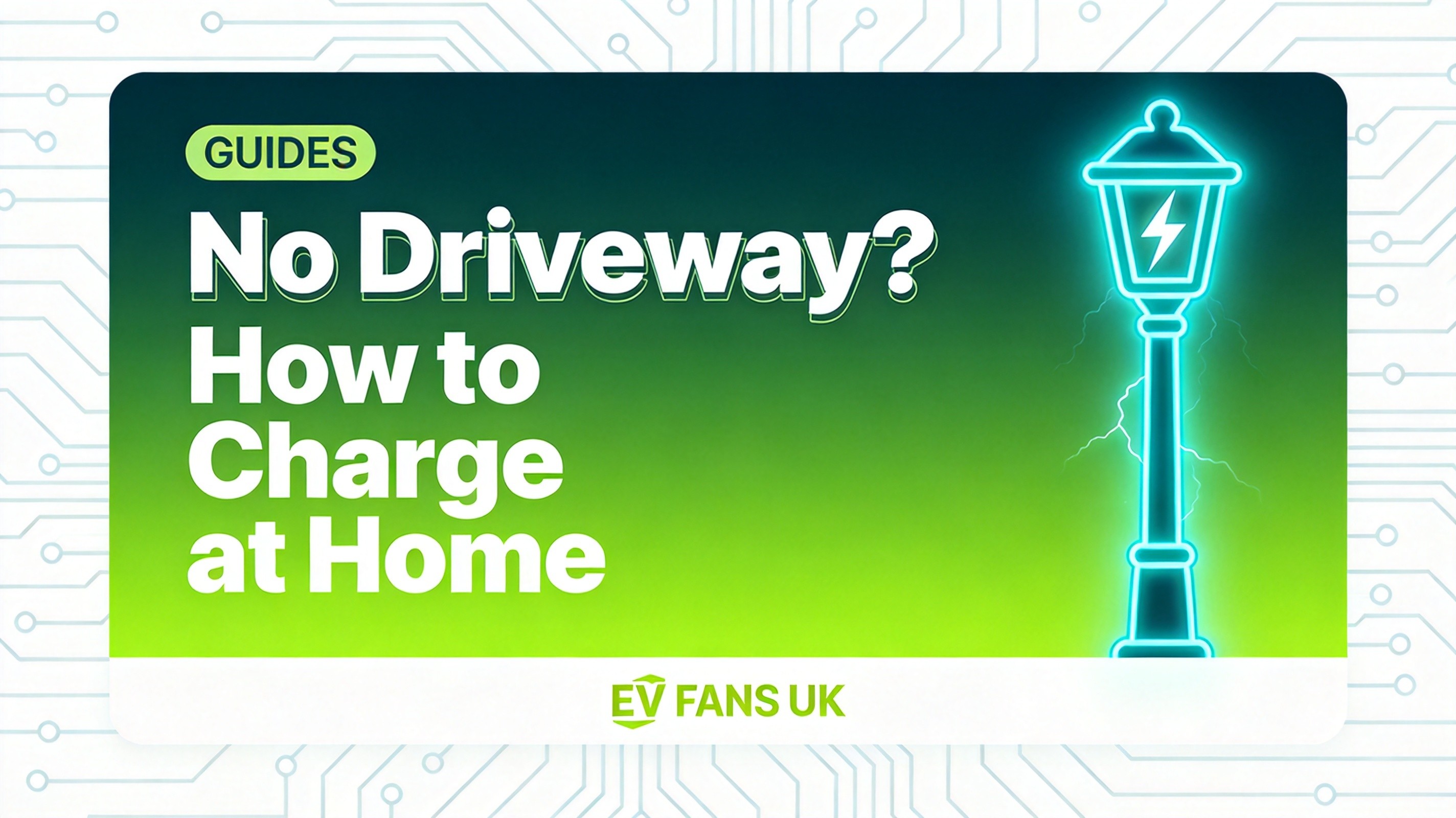
The fastest-growing solution is the simplest: put chargers where the parking already is. On-street specialists such as char.gy mount charge points inside lamp posts, which avoids new street furniture and taps into existing electrical infrastructure.
The numbers show how quickly this segment is scaling. char.gy's annual impact report, published in September 2026, showed active sockets rose 28% over the year to 4,978, and that it delivered 14.4 million kWh of renewable electricity — a 40% increase, ahead of socket growth, indicating rising utilisation. It won six further LEVI contracts during the year, taking its total to eight, has around 20,000 sockets under awarded contracts, and raised a further £5 million in August 2026.
Councils are rolling out their own networks too: North Northamptonshire has delivered 87 dual-socket 22kW on-street charge points plus six rapid 50kW sites and is bringing forward a further programme with Connected Kerb, while char.gy is contracted to deliver 3,000 on-street chargers across West Northamptonshire.
Best for: residents who can reliably park near home. Watch out for: bay availability — a charger is no use if someone else is parked on it, and coverage remains patchy.
Option 2: Cross-pavement cable channels
If you have a wall to mount a charger on and street parking outside, a cross-pavement channel is the closest thing to normal home charging. A gully is installed flush into the pavement so you can run a cable safely from your own wallbox to the car on the street. It is currently the only approved method for running a charging cable across a public footway.
Slough Borough Council received £130,000 from the Department for Transport's Electric Vehicle Pavement Channels Grant (EVPCG) and began a one-year trial with partner Kerbo Charge on 12 August 2026, covering 20 installations. Residents accepted onto the trial pay £399 towards installation and arrange their own wall-mounted charger; the most suitable properties are those where you can normally park outside your home and there is a ground-floor electricity supply. The council estimates the arrangement could save residents around £4,000 a year compared with relying on public charging — the clearest illustration of why charging at home matters so much. Run your own numbers with our charging cost calculator.
Best for: houses and ground-floor flats with a legal right to park outside and a suitable supply. Watch out for: council variation — some authorities run active channel programmes, others have none. Ask your highways team first.
Option 3: Grants you can actually claim
From April 2026 the maximum support available through the relevant charging grant schemes increased from £350 to £500 per charging socket, and the programmes for renters, landlords and businesses were extended until March 2027. The schemes that matter to households without a driveway are:
EV chargepoint grant for renters and flat owners — up to £500 towards installing a charge point, for people who rent or own a flat and have private off-street parking they have a legal right to use.
On-street parking grant — up to £500 for households with only on-street parking, where the installation includes a cross-pavement charging solution.
Workplace Charging Scheme — up to £500 per socket, for up to 40 sockets, for businesses, charities and public sector organisations.
Note the eligibility split: homeowners with an existing driveway are generally not eligible for the main home charging grant, and most schemes require private off-street parking. If you have no driveway at all, the cross-pavement route is the one to pursue. Our full breakdown is in UK electric car grants and incentives 2026.
Option 4: Push your council — and track what is already funded
Because LEVI money goes to local authorities, the pace of delivery varies enormously by postcode — but funded programmes are now moving into delivery, so there are timelines you can track. Oxfordshire is a good example: on 3 September 2026 the county council approved its first 11 on-street charging sites as part of a £4 million government-funded programme to install more than 1,500 public chargers by summer 2028. It targets the estimated 30% of Oxfordshire residents without a driveway, and includes a strand letting residents apply for EV cable channels outside their homes.
That mix — public chargers, residents' cable channels and community microhubs — is becoming the English template. Ask your council three questions: is there a LEVI allocation, who is the delivery contractor, and is a residents' cable channel scheme planned? In the meantime, our UK charging points directory covers the public network you can use today, town by town.
What it actually costs
Public pricing varies by power and location. For reference, when TotalEnergies began its Transport for London rapid rollout in September 2026, introductory pricing was 54p/kWh at 50kW rapid points and 59p/kWh at 150kW ultra-rapid points. Home-style charging is where the real saving sits: moving everyday charging off the rapid network is the single biggest running-cost decision an EV owner without a driveway can make. Check what vehicle tax you would pay with the VED calculator.
Your practical checklist
1. Find out whether your property has a legal right to park outside it — this determines almost everything.
2. Check your council's LEVI allocation and on-street programme before spending private money.
3. If you have a wall and street parking, ask about cross-pavement channel schemes and the £500 grant route.
4. Model the real cost of the cars you are considering — charging speed matters as much as headline range when you cannot charge at home. Start with the electric car library or compare two models directly with the car comparison tool.
And if public charging is going to be part of your routine for a while, read our guide to the UK's 99% charger reliability law — including what you can claim back when a charger fails — and this week's World EV Day 2026 round-up of new ultra-rapid capacity.
Sources
Oxfordshire County Council — First sites approved for Oxfordshire's electric vehicle charging programme (https://news.oxfordshire.gov.uk/first-sites-approved-for-oxfordshires-electric-vehicle-charging-programme/) · Slough Borough Council — Cross-pavement electric vehicle charging trial has begun (https://www.slough.gov.uk/news/article/692/cross-pavement-electric-vehicle-charging-trial-has-begun) · Transport + Energy — char.gy cuts emissions by almost a quarter as it expands network (https://transportandenergy.com/2026/09/07/char-gy-cuts-emissions-by-almost-a-quarter-as-it-expands-network/) · North Northamptonshire Council — Find an electric vehicle chargepoint (https://www.northnorthants.gov.uk/electric-vehicle-charging/find-electric-vehicle-chargepoint) · Zapmap — TotalEnergies begins delivery of TfL Rapid and Ultra-rapid charging rollout across London (https://www.zapmap.com/news/totalenergies-begins-delivery-tfl-rapid-and-ultra-rapid-charging-rollout-across-london) · Motoreasy — Government grants for EV owners (https://www.motoreasy.com/magazine/869/Government-grants-for-EV-Owners) · News From Wales — on the £381m LEVI Fund (https://newsfromwales.co.uk/the-race-to-install-why-england-is-pulling-ahead-on-on-street-ev-charging-and-what-wales-needs-to-do-to-keep-up/).