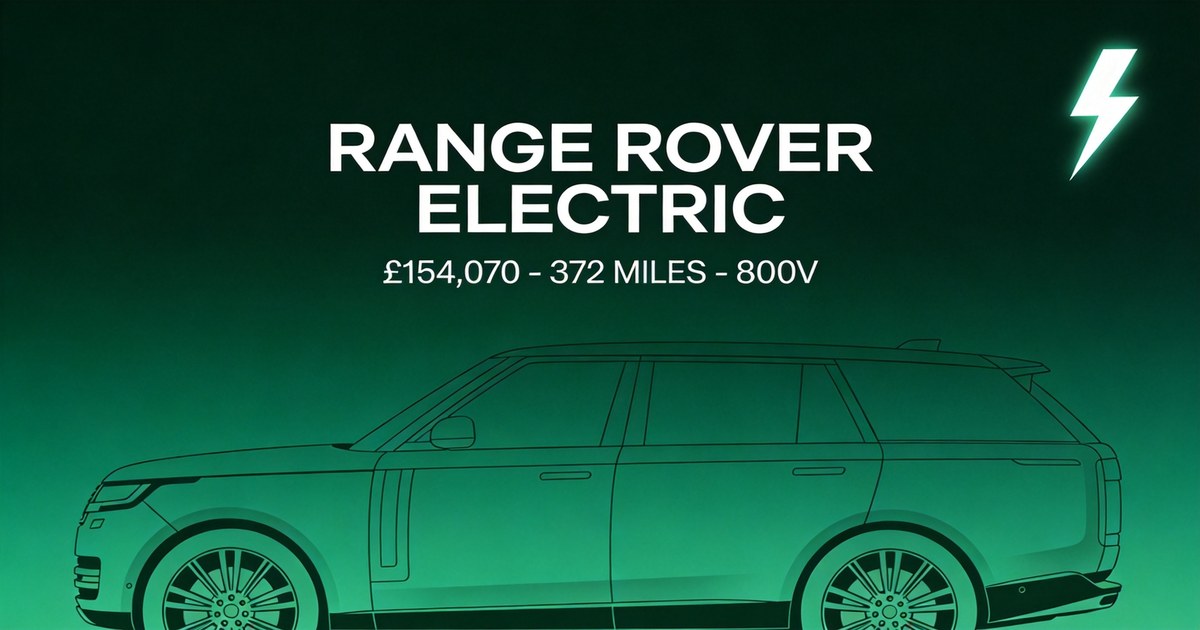
After years of anticipation and a waiting list that opened back in 2023, the Range Rover Electric has finally entered production and order books are open in the UK. Revealed on 2 September 2026, the first battery-powered Range Rover wears the EV550 badge and kicks off from £154,070 on-the-road for the Short Wheelbase Autobiography. It is built at Solihull alongside the existing mild-hybrid, plug-in hybrid and ICE models.
According to JLR's official announcement, the launch marks "a new era of enhanced refinement and capability" for the brand's flagship. The question on everyone's mind: does an electric Range Rover still feel like a Range Rover? Let's break down the specs.
Powertrain, battery and charging
The Range Rover Electric uses a pair of identical 260 kW permanent magnet synchronous motors — one on each axle — producing a combined 550 PS and 850 Nm of torque. That's more torque than any production Range Rover in history. 0–60 mph takes 4.3 seconds and top speed is 125 mph.
Energy comes from a 118.5 kWh usable double-stacked lithium-ion battery pack with 344 prismatic cells, mounted low in the MLA Flex platform. The 800-volt architecture enables 350 kW DC rapid charging, taking the battery from 10–80% in around 22 minutes or adding up to 137 miles (220 km) in 10 minutes at peak rate.
- WLTP range: up to 372 miles
- Real-world range: up to 333 miles (JLR estimate)
- Battery: 118.5 kWh usable, double-stacked prismatic
- Charging: 350 kW DC, 10–80% in ~22 min
- Power: 550 PS / 850 Nm
- 0–60 mph: 4.3 seconds
JLR claims the battery comes with its own ThermAssist heat management system — one of 300 patent applications filed for the vehicle — which coordinates battery, motor and cabin thermal energy to add up to 40 km of range while cutting heating energy use by 40%. Every vehicle also gets a Battery Digital Twin monitoring over 900 diagnostic data points, enabling predictive maintenance via over-the-air software updates. The battery itself is covered by an 8-year / 100,000-mile warranty.
It's still a Range Rover first
Visually, the Electric barely gives itself away. The most obvious changes are an aerodynamically optimised grille, new aero wheel designs and a sculpted underbody — all designed to maximise motorway efficiency rather than scream "EV".
Off-road capability hasn't been watered down. A new Integrated Traction Management system responds in as little as 50 milliseconds — JLR says that's 100 times faster than a combustion equivalent. Rear-axle torque can be varied between 100% and 0% continuously. The lower centre of gravity (88 mm lower than the V8) and twin-chamber air suspension are said to improve on-road dynamics too.
Ground clearance is 29 mm lower than ICE models at maximum height, but wading depth stays at 900 mm. Single-pedal driving can launch on a 33-degree slope and climb up to 45 degrees in rolling mode. Towing capacity is 2,500 kg.
Trim levels and pricing
Eight derivatives are available from launch, spanning both standard and long-wheelbase bodies:
- EV550 Autobiography SWB: £154,070
- EV550 First Edition SWB: £157,610 (Belgravia Green, Santorini Black or Varesine Blue)
- EV550 Autobiography LWB: from ~£170,000
- EV550 SV SWB: £176,000+
- EV550 SV Ultra LWB: £215,670
- EV550 SV Black LWB: £225,240
Standard equipment across the range includes 22-inch alloys, active noise cancelling, four-zone climate with air purification, panoramic sunroof, heated and ventilated massage front seats, and a Meridian sound system. First Edition models add a centre-console fridge, tailgate event seating and illuminated treadplates.
Want to compare the Range Rover Electric against rivals like the Mercedes-Benz EQS SUV or BMW iX? Head over to our EV car comparison tool and see how they stack up on range, price and running costs.
Built in Britain, but is it worth the money?
The Range Rover Electric is built at Solihull, with batteries and motors manufactured at JLR's Electric Propulsion Manufacturing Centre in the UK. It's been tested across more than one million physical miles — the equivalent of 38 laps around the world — plus 250,000 hours of virtual simulation.
At £154,070, it lands just £800 below the Mercedes-AMG G 580 electric and significantly above the Tesla Model X and BMW iX. But for buyers who want the Range Rover badge, the ride quality and the uncompromised off-road ability, there simply isn't a direct electric competitor. The EV Fans car database has full specs and comparison tools if you're weighing alternatives.
First deliveries are expected between October and December 2026. If you're considering one, our VED tax calculator and charging cost calculator can help you work out the real running costs compared with a petrol or diesel alternative. And with a battery this size, you'll want to check UK charging points near your regular routes.
And if a full-size Range Rover Electric is out of reach, a Range Rover Sport Electric is expected to follow in 2027, likely using the same 800V architecture at a lower price point. We'll cover that as soon as details emerge — make sure you're following our news section for the latest.
Curious how the 76-plate window is shaping up for other EVs? Our round-up of the best 76-plate EV deals has everything from superminis to luxury SUVs.
Sources: JLR Media Centre (2 Sep 2026), PistonHeads (2 Sep 2026), Electrifying.com (2 Sep 2026).