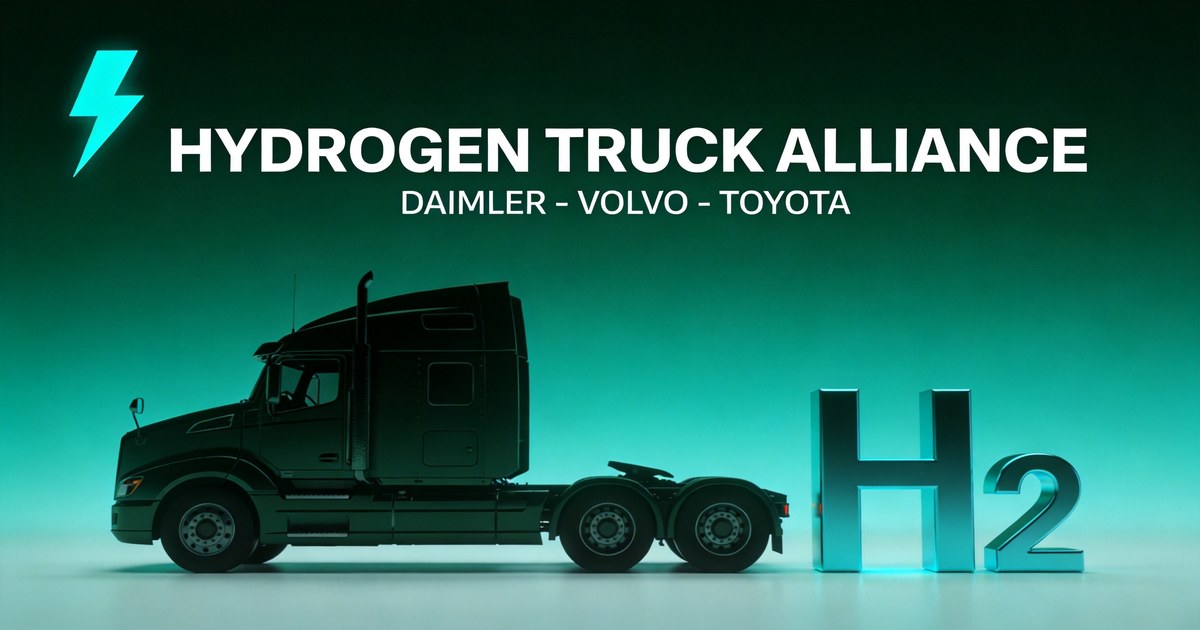
In what could prove a pivotal moment for heavy-duty zero-emission transport, a coalition of industry heavyweights has announced plans to build a fully integrated hydrogen truck ecosystem in Germany. The initiative, revealed on 3 September 2026, brings together vehicle manufacturers, energy suppliers and component makers under a shared ambition to scale hydrogen mobility by 2030.
According to Daimler Truck's official press release, the group says it represents "the first time in Europe" that the full value chain — policy, vehicles, infrastructure and supply — has been coordinated at this scale.
Who's in the alliance?
The founding members read like a who's who of trucking and energy:
- OEMs: Daimler Truck, Volvo Group, Toyota Motor Corporation
- Component maker: Bosch
- Gas / energy suppliers: Air Liquide, TotalEnergies
- Infrastructure & operations: TEAL Mobility, MB Energy
Full details — including the alliance's official name, investment figures and specific deployment targets — will be unveiled at a CEO-led press event during IAA Transportation in Hanover on 15 September 2026. But even from the pre-announcement, the outline is clear.
What the alliance plans to do
The stated goals are threefold:
- Build the vehicle offering. Daimler Truck, Volvo and Toyota already share fuel-cell technology through cellcentric — the 50:50 joint venture between Daimler and Volvo that Toyota is joining as an equal one-third shareholder, following a binding agreement signed in July 2026. cellcentric develops and produces fuel-cell systems for heavy-duty applications from its base in Germany.
- Deploy hydrogen refuelling stations. Stations will be rolled out along "key strategic corridors in Europe" in sync with the launch of hydrogen truck fleets. Air Liquide and TotalEnergies bring the infrastructure and supply expertise, while TEAL Mobility and MB Energy handle operational aspects.
- Hit a competitive hydrogen price. The alliance says it wants fuel priced low enough to give hydrogen trucks a competitive total cost of ownership (TCO) versus diesel — the metric fleet operators actually care about.
This ecosystem approach is significant because hydrogen's biggest barrier isn't the trucks themselves — it's the chicken-and-egg problem of who builds refuelling stations without a critical mass of vehicles, and who buys the vehicles without stations. By coordinating the rollout on both sides, the alliance is trying to break that deadlock.
Why Germany, and why now?
Germany has long positioned itself as Europe's industrial heartland for hydrogen. The country's National Hydrogen Strategy and generous state backing for H2 infrastructure make it the natural test bed. The IAA Transportation show in Hanover — the world's largest commercial vehicle exhibition — provides the perfect launch stage.
The timing also reflects a reality that's becoming clearer across the industry: battery-electric trucks can't do everything. For long-haul HGVs covering 500+ miles per day with heavy payloads, hydrogen fuel cells offer faster refuelling (10–15 minutes), longer range and less weight penalty than batteries. That's why EU policy and fleet operators are increasingly looking at a mixed-technology future — batteries for urban and regional distribution, hydrogen for long-haul.
What this means for the UK
Britain has been relatively cautious on hydrogen for HGVs compared with Germany. The UK government's ZEV mandate covers cars and vans, and a separate HGV decarbonisation strategy is still taking shape. Here's what the German alliance signals for UK logistics:
1. It validates hydrogen as a real long-haul solution
When three of the world's biggest truck makers team up with two major energy companies, it's harder to dismiss hydrogen as a niche or experimental technology. UK fleet operators watching from the sidelines will likely take note: if Germany scales hydrogen successfully, British operators running European routes will want access to the same refuelling network.
2. The UK risks falling behind on H2 HGV infrastructure
The UK currently has fewer than 20 public hydrogen refuelling stations, and most are car-focused. Germany already has over 100 and is planning hundreds more for trucks. If the alliance's corridor network spreads across the EU but stops at the Channel, UK hauliers running international routes face a competitive disadvantage.
3. cellcentric's technology could be the global standard
With Toyota — the world's most experienced fuel-cell developer — now joining cellcentric on equal terms, the JV's technology has a strong chance of becoming the dominant heavy-duty fuel-cell platform. That matters for the UK because whatever trucks British fleets eventually buy will likely use cellcentric-derived systems.
4. UK policy needs to pick up the pace
The UK's 2040 ban on new diesel and petrol HGVs (for vehicles under 26 tonnes; 2035 for some categories) leaves plenty of time, but infrastructure takes years to build. The German model — coordinating OEMs, energy firms and government in a single ecosystem — is a template the Department for Transport may want to study closely.
Looking ahead: IAA Transportation, 15 September
We'll get the full picture in mid-September when CEOs from all the member companies take the stage in Hanover. Expected announcements include concrete station numbers, corridor maps, fleet deployment targets and — crucially — how the alliance will expand beyond Germany into the rest of Europe.
For UK readers tracking the transition to zero-emission freight, this is definitely one to watch. You can compare the running costs of electric vs diesel for your own fleet using our EV charging cost calculator, or explore current electric HGV options in the EV Fans car database.
For passenger EV drivers, the indirect effects matter too: as hydrogen finds its natural home in heavy transport, it frees up grid capacity and policy focus for battery-electric cars and vans — ultimately accelerating the rollout of public charging infrastructure for everyone. If you're shopping for an EV this September, don't miss our round-up of the best 76-plate EV deals.
And if you're interested in how luxury SUVs are going electric, check out our Range Rover Electric launch coverage — another milestone for UK-built zero-emission vehicles.
Sources: Daimler Truck press release (3 Sep 2026), Volvo Group News (3 Sep 2026), Electric Cars Report (31 Jul 2026).